Biomedical Science (Human Biology)
A foundation in the biological systems that underpin human health and behaviour. Emphasis on the cellular and genetic mechanisms behind tumours.
An interest in how living systems work, and how we perceive and interact with the world.
A foundation in the biological systems that underpin human health and behaviour. Emphasis on the cellular and genetic mechanisms behind tumours.
A study programme that focuses on cognition, attention, and experimental research with behavioural data.
I was especially curious about how virtual reality is used in psychology-based experiments. This led me to the world of neuroscientific psychology, a discipline that seeks to understand the cognitive mechanisms that drive certain behaviours. I decided to write my thesis in this field because the required skill set was exceptionally interesting to me. It required an understanding of logical systems and how multiple systems connect to one another, an aptitude for technology and the ability to learn how to work with new software, and an intuition for human behaviour and psychology.
At first, I had to learn how to work with VR and design an environment, something that I learned through online videos and tutorials. To share the knowledge I acquired with future students, designing a beginner-friendly VR video tutorial accompanied by a wiki became part of my master’s project. For this purpose, I learned how to make and edit videos and how to design and manage a wiki. The materials were published on the internal website of the theoretical neuroscience working group at Philipps University and are not publicly available. However, some of my work can be seen and downloaded here.
After a small advertisement campaign and some budget negotiations, 52 participants were invited to partake in the experiment. The goal was to create a semi-naturalistic environment and use it to study how attention could be shaped by previous behaviour.
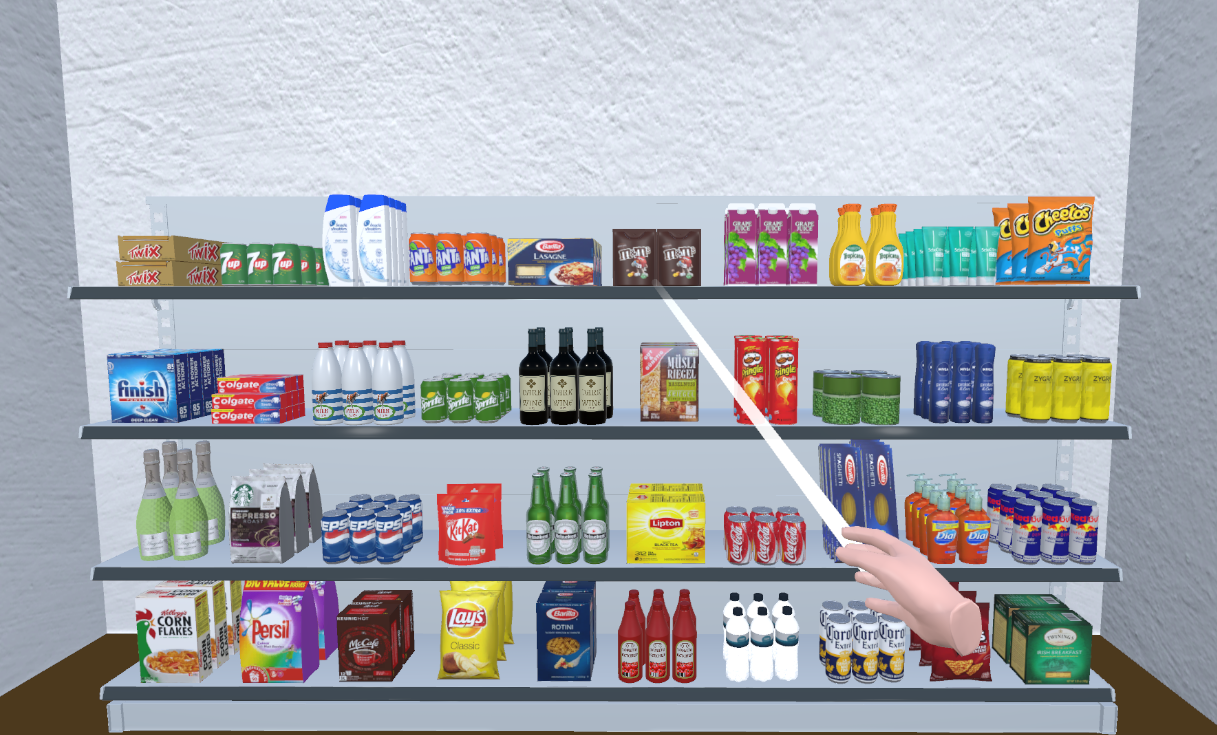
The experiment was intended to show how repeatedly selecting a specific target could shape behaviour. In the training phase, the Learning group had to find the red Pringles target on most trials. In the main phase, the colour of the Pringles pack was switched from red to green, and its probability was equalised with that of the other targets. In comparison, the Control group did not receive increased exposure to any specific target.
Drag through eight blocks to compare the groups. Lower reaction times mean faster responses.
The results suggest that repeated selection of a specific target can shape expectations, which may then hamper performance when conditions change.